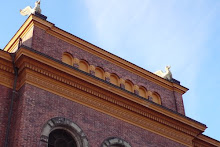
Magnús Pálsson,
artist, Reykjavík 03.06. 2009
It is rather sad that the Norwegian Ministry of Culture should be fanatically focused on uniting all the major museums in Oslo under one roof. The idea seems to be that the entire Norwegian art and craft scene and history can be viewed in a few hours because it wll seem more efficient and modern yuppie-day man does not have the time to spend on art. No time to think, enjoy, feel and meditate with art.
A few years ago London had a lot of incentive to follow this trend when modern art in this capital city needed space. The British did however not break up the pattern of individual museums. They converted the old Bankside Power Station into the new Tate Modern, extended the National Gallery by the Sainsbury Wing and brought new life to the functioning of old institutions like the Tate Gallery, The Victoria and Albert Museum and even the National Portrait Gallery. This policy seems to have worked well in London and the Tate Modern is now one of the most successful cultural institutions in the world.
Magnús Pálsson, artist, Reykjavík
Les innlegg på norsk (PDF)
Viser innlegg med etiketten English post. Vis alle innlegg
Viser innlegg med etiketten English post. Vis alle innlegg

From Jeff Wall
I like old museums, especially when they retain their original character, or at least don’t depart too much from it. I also like new ones, when they are done well. So I am not a supporter of old as opposed to new museums. I am only a supporter of good ones. By good, I mean ones that have a certain soul, as well as having fundamental quality in the design and execution. And of course, whose collections are worth seeing repeatedly. I think some new galleries and museums already do have that kind of soul, that individual, even idiosyncratic character that will be appreciated more and more as they age. The National Gallery in Oslo is a place where I experienced the presentation of a significant moment in the evolution of modern art. The presentation is a combination of the pictures in the collection, the way they are presented, and the nature of the building. Things have moved on from the moment captured in that presentation, and the situation there is no longer ‘of the moment’. It is isolated in time and space and it seems not to be related to the art of the present. But this is an illusion because the capture of this moment continues to be available to contemporary experience. We can revisit that moment any time we enter the National Gallery. If the moment were insignificant, we would not likely be very interested in revisiting it. But I believe it is significant, both for the Norwegian people and for foreigners like me. I had a beautiful afternoon looking at the collection in the rooms in which it was originally installed. I could not think of a better way to look at the work of Christian Krohg, Munch, and others. I am sure I will never forget those hours and that the experience has affected my life and work in some meaningful way. There are good architects making good buildings today; but I am not sure whether any contemporary museum designs improve on the serenely proportioned and beautifully lit rooms of places like the National Gallery. At best, they provide an up-to-date version of the same thing. Otherwise, they are simply less good, and therefore represent a decline in the manner of presenting works of art. I’ve visited and exhibited in scores of museums, but I remember many of them less than I do the National Gallery. I believe the National Gallery is one of a diminishing number of superb situations for engaging with art. Superb in their tasteful design and regard for the collections they protect, and superb in preserving a sense of what the art has meant in the place and to the people who live there. I think it is wrong to look at the National Gallery as ‘old’, just as it is wrong to look at the art of Edvard Munch as ‘old’. These accomplishments do not age the way other things do. Their capture of the moment in which they were created banishes the mundane passing of time and creates a permanent present. The sick girl in Munch’s picture will always be ill; she will never recover and she will never die. And that tells us about how to look at the museum where that girl can be visited: it will never be contemporary and it will never be outmoded.
Dear Carina & Ingrid,
Here’s a note about the gallery and how I see it.
I hope it will be of some help.best regards,
Jeff
Dear Carina & Ingrid,
Here’s a note about the gallery and how I see it.
I hope it will be of some help.best regards,
Jeff
fredag 8. mai 2009
Demo: Nasjonalgalleriet fra Andre Gali
Gathering outside Nasjonalgalleriet in Oslo to protest against moving the museum to vestbanen
http://www.galiblog.com
tirsdag 7. april 2009
Everyone feels for the National Gallery by Mari Slaattelid
The proposal to move the National Gallery was until recently just as unthinkable for those in power as it was for the general public. The planned new large museum was to be built at Tullinløka, thereby linking up the National Gallery to the projected new edifice. The present proposal to build at Vestbanen was so spectacular that Parliament and others involved did not fully understand the direct consequence of the decision: that the National Gallery was left out. In order to complete the plans for an entire museum district at Aker Brygge, the irretrievable loss of the National Gallery was glossed over. The 400 000 visitors that make their way up Karl Johan Street to find the National Gallery in the centre of town every year will secure the financial aspect of the planned museum district. The Munch room as well as the paintings of Tidemand and Gude have a popular appeal that is lacking in contemporary art and design. So forget about leaving behind the central part of town with shops and offices and scattered theatres.
Some have argued for a divided solution whereby the old National Gallery can continue its present function. The dynamic Minister of Culture has advised “all those who are concerned” that the debate cannot go on for long. Assurances have been made that the collection will be well looked after, and hints have been dropped about the old edifice being used for cultural purposes in the future. But the campaign to save the National Gallery is not just aimed at preserving the building, nor are we against the decision made in 2003 to merge the museums.
People from the arts and cultural circles are being circumspect and strategic when discussing the present situation. Aftenposten`s editorial looked back from our affluent present on a poorer era`s monument, an interesting perspective that supports a state management lacking in both respect and values. Audun Eckhoff ,the director of the National Gallery, argues that Oslo`s climatic conditions as well as technical challenges pose insurmountable problems. Those who are maneuvering the National Gallery towards the brink are increasing the pressure and Eckhoff must now have his hands full trying to hang on. Perhaps there has not been enough time to get advice from the national gallery in Stockholm ( cost of renovation: a billion kroner), Helsinki or St. Petersburg, all of these buildings being made of brick and built around the same time and at the same latitude as Oslo.
Nearly everyone passing in front of the National Gallery`s blighted façade has signed the campaign`s petition.They understand intuitively that Nidarosdomen, Stortinget , the building at Eidsvoll and the National Gallery are institutions where usage and content give the buildings their significance. The planned move is akin to wiping out traces that can be recognized by people the world over. Newspaper readers are indignant concerning the minister of culture`s arrogance in pushing ahead with his plans. This spontaneous reaction speaks volumes about the value of the National Gallery
Minister Giske describes the motives of the opposition in a misleading way: “ Those who are using the appeal to save the National Gallery as an argument against the merging of the National museums have to admit that their case is a lost one” ( Aftenposten 31.03.09) Or “ If those who are now fighting to save the National Gallery mean the building itself , then they have already won. They can use their efforts for other things. If they are concerned with the future use of the building for new purposes, they have got a strong case “ ( Morgenbladet, week 13, 2009). After a short break given over to the economic aspects, the closing down of the National Gallery is once again a so-called political decision. But then why is the minister being so generous towards any week long arrangement that smacks of well-fed cultural festivities, and why is he so being harsh towards that which he and every Norwegian has inherited in terms of cultural self esteem and continuity, values that are just as invisible to the minister as they are for us all, and the very values which are for him to protect in his capacity as minister of culture.
This treasury of collective memory is here to shape the future of Norwegian rock poets, to mention a group that tends to have the minister`s sympathy. Taking away Europe`s common history from poets and others is not just irresponsible and disloyal: this point may be proven already in the forth coming Autumn election.
Mari Slaattelid
Visual artist
Some have argued for a divided solution whereby the old National Gallery can continue its present function. The dynamic Minister of Culture has advised “all those who are concerned” that the debate cannot go on for long. Assurances have been made that the collection will be well looked after, and hints have been dropped about the old edifice being used for cultural purposes in the future. But the campaign to save the National Gallery is not just aimed at preserving the building, nor are we against the decision made in 2003 to merge the museums.
People from the arts and cultural circles are being circumspect and strategic when discussing the present situation. Aftenposten`s editorial looked back from our affluent present on a poorer era`s monument, an interesting perspective that supports a state management lacking in both respect and values. Audun Eckhoff ,the director of the National Gallery, argues that Oslo`s climatic conditions as well as technical challenges pose insurmountable problems. Those who are maneuvering the National Gallery towards the brink are increasing the pressure and Eckhoff must now have his hands full trying to hang on. Perhaps there has not been enough time to get advice from the national gallery in Stockholm ( cost of renovation: a billion kroner), Helsinki or St. Petersburg, all of these buildings being made of brick and built around the same time and at the same latitude as Oslo.
Nearly everyone passing in front of the National Gallery`s blighted façade has signed the campaign`s petition.They understand intuitively that Nidarosdomen, Stortinget , the building at Eidsvoll and the National Gallery are institutions where usage and content give the buildings their significance. The planned move is akin to wiping out traces that can be recognized by people the world over. Newspaper readers are indignant concerning the minister of culture`s arrogance in pushing ahead with his plans. This spontaneous reaction speaks volumes about the value of the National Gallery
Minister Giske describes the motives of the opposition in a misleading way: “ Those who are using the appeal to save the National Gallery as an argument against the merging of the National museums have to admit that their case is a lost one” ( Aftenposten 31.03.09) Or “ If those who are now fighting to save the National Gallery mean the building itself , then they have already won. They can use their efforts for other things. If they are concerned with the future use of the building for new purposes, they have got a strong case “ ( Morgenbladet, week 13, 2009). After a short break given over to the economic aspects, the closing down of the National Gallery is once again a so-called political decision. But then why is the minister being so generous towards any week long arrangement that smacks of well-fed cultural festivities, and why is he so being harsh towards that which he and every Norwegian has inherited in terms of cultural self esteem and continuity, values that are just as invisible to the minister as they are for us all, and the very values which are for him to protect in his capacity as minister of culture.
This treasury of collective memory is here to shape the future of Norwegian rock poets, to mention a group that tends to have the minister`s sympathy. Taking away Europe`s common history from poets and others is not just irresponsible and disloyal: this point may be proven already in the forth coming Autumn election.
Mari Slaattelid
Visual artist
lørdag 28. mars 2009
MEET UP AND FORM A RING ROUND NASJONALGALLERIET !
PRESERVE NORWAY’S NATIONAL GALLERY
Saturday 28th March at 2pm
MEET UP AND FORM A RING ROUND NASJONALGALLERIET !
The collection fund for saving the National Gallery “Redd Nasjonalgalleriet” begins on the 25th of March
IT IS STANDARD PRACTICE THE WORLD OVER NOT TO SHOW OLD AND NEW ART IN THE SAME BUILDING
IN RECENT YEARS IT HAS BECOME COMMON PRACTICE TO BUILD SEPARATE MUSEUMS FOR DIFFERENT HISTORICAL PERIODS
THE PLAN TO ASSEMBLE OSLO’S THREE MAIN MUSEUMS IN ONE EDIFICE WILL MAKE NORWAY MORE PROVINCIAL
THE NATIONAL GALLERY WAS BUILT TO HOUSE THE PRESENT COLLECTION
IT IS NOT JUST A SHELL
IF THE COLLECTION IS REMOVED TO NEW PREMISES IT WILL BE REDUCED BY HALF
REMOVING THE COLLECTION CAUSES A BREAK IN HISTORY AND WILL RESULT IN WIDESPREAD NOSTALGIA
THE NATIONAL GALLERY’S COLLECTION IS AN INSTALLATION
INSTALLATION IS THE ART OF THE FUTURE
TO MERGE MUSEUMS TOGETHER IN A SHARED BUILDING IS TO MIME CULTURE
Ingrid Book & Carina Hedén
The signatory’s list is available at: www.bevarnasjonalgalleriet.org
( signatur@bevarnasjonalgalleriet.com )
You will find more information including translations at: www.kunstkritikk.no
Please pass this e-mail on to anyone you think may be interested
Saturday 28th March at 2pm
MEET UP AND FORM A RING ROUND NASJONALGALLERIET !
The collection fund for saving the National Gallery “Redd Nasjonalgalleriet” begins on the 25th of March
IT IS STANDARD PRACTICE THE WORLD OVER NOT TO SHOW OLD AND NEW ART IN THE SAME BUILDING
IN RECENT YEARS IT HAS BECOME COMMON PRACTICE TO BUILD SEPARATE MUSEUMS FOR DIFFERENT HISTORICAL PERIODS
THE PLAN TO ASSEMBLE OSLO’S THREE MAIN MUSEUMS IN ONE EDIFICE WILL MAKE NORWAY MORE PROVINCIAL
THE NATIONAL GALLERY WAS BUILT TO HOUSE THE PRESENT COLLECTION
IT IS NOT JUST A SHELL
IF THE COLLECTION IS REMOVED TO NEW PREMISES IT WILL BE REDUCED BY HALF
REMOVING THE COLLECTION CAUSES A BREAK IN HISTORY AND WILL RESULT IN WIDESPREAD NOSTALGIA
THE NATIONAL GALLERY’S COLLECTION IS AN INSTALLATION
INSTALLATION IS THE ART OF THE FUTURE
TO MERGE MUSEUMS TOGETHER IN A SHARED BUILDING IS TO MIME CULTURE
Ingrid Book & Carina Hedén
The signatory’s list is available at: www.bevarnasjonalgalleriet.org
( signatur@bevarnasjonalgalleriet.com )
You will find more information including translations at: www.kunstkritikk.no
Please pass this e-mail on to anyone you think may be interested
fredag 27. mars 2009
Lotte Konow Lund - Morgenbladet
“Someone ought to wish to remember those things which others wish to be forgotten.”
Georg Johannesen
Whilst I was still studying at the Academy of Fine Arts in Oslo in 1995, the Education Minister Gudmund Hernes came to talk to us. His visit was occasioned by the controversial appointment of Odd Nerdrum as Professor at the Academy. Minister Hernes came to rebuke students and staff for their opposition to both the appointment as well as their opposition to the planned merging of the Academy with the Oslo National Academy of the Arts.
As a student I saw this meeting as a link in a series of cases in which we were out of our depth. We understood what was being discussed, but were unable to grasp the consequences. The experience was both frustrating and led to a feeling of powerlessness. We understood that we should express our point of view, that it was now or never, but instead found that what we said was not taken seriously. Worse still, we realized that decisions which would change conditions at the Academy for ourselves as well as future generations of artists, had been made beforehand. Minister Hernes was here to rebuke us , not talk with us.
Time has shown that the merging with the Oslo National Academy of the Arts was to have much greater and more serious consequences than the appointment of a Professor in figurative art: Jan Sæther took up the position after Odd Nerdrum withdrew his application.
Towards the end of the meeting with Minister Hernes, having managed to overcome my fear due to the large number of journalists present, I asked the minister if this was the way that the Labour party carried out its cultural policies, by overriding and not listening, by overseeing and eliminating artistic independence. I remember this so well, because I was genuinely surprised by Hernes` dominant manner, and by the strong reaction of the assembled press.
I have since thought that I had pointed out something important without quite being aware of the whole situation. The Labour party carried out there and then a policy that it will have to answer for in the future. One can therefore rightly question whether a political party`s policies lack foresight and long term perspectives.
We are at present at the same stage in a similar process. It has taken many of us some time to understand that as a consequence of the present government`s decision to build a new museum, two of Oslo`s main museums will be closing down. It is important that both the government and its cultural minister understand the signals they are giving out by not listening.
The city of Oslo has undergone continual change in recent years. The biggest building boom and inner city expansion since the 50`s and 60`s continues unabated. The success of the new Opera building has had a cumulative effect, but it is easy to forget that it took eight years to reach the decision to build it. By way of contrast, it took , if I am not mistaken, two hours to decide to go ahead and build Hotel Opera, the yellow building that now lies between the Opera house and Oslo`s main railway station. Whether it is a question of saving time or money, it seems strange from a political point of view that a public debate has not been thought necessary. This is all the more surprising as a vital decision concerning our cultural future is being made in an election year.
On the other hand it seems to be the case that when one wishes to accomplish something significant and necessarily controversial in a democracy, without opposition, the most appropriate strategy is to coax the case forward millimetre by millimetre until all the appropriate contracts are signed. In this way each citizen will be aware of their democratic right to protest, but they must bear the responsibility of not having used that right on the day that they understood the consequences.
One of the arguments used to justify the building of a new large museum is that the public can save time once all artforms are collected in one edifice. Not only artists are astonished at such reasoning, but it does say a lot about how art is perceived. To walk around a city is an integral part of a cultural experience. Who looks at art to save time? Who wants a city built to save time? Buildings and urban spaces are collective memories, and the city represents our common understanding of reality. Architecture plays a role in defining who we are in a society, how we relate to each other, how we move and the whole context is decisive in how we experience the content in each and every building. Hotel Opera is just as real as the Opera, and it defines how one reads the activities inside the Opera building. But no one saw the building before it stood there.
It is not hard to see that we need a new museum for contemporary art. The museum at Bankplassen has hardly been mentioned, let alone visited, since the exhibition Kyss Frosken signalled a transitional phase. Today most of us are uncertain as to the building`s purpose. The bookshop has moved out, leaving an empty space with a few wires sticking up from the floor. The last time I was there the ground floor rooms were partially in darkness, the rest being used for children`s workshops. The rental sum for such a building would make a solid contribution to the new museum that contemporary art in Norway deserves. In the meantime we have hardly seen any shows of contemporary Norwegian art arranged by the National Museum, and just as with other aspects of cultural life here, private initiatives fill the gap.
This is not quite in the spirit of a red-green government alliance.
Exhibiting all art-movements in one edifice will leave us worse off than before. We will not only lose buildings whose main significance is related to their present location, but the Conglomerate Museum will imply that our history of art does not deserve more than one edifice. Artists are justifiably concerned as to whether the autonomy of their respective practices will be threatened.
As a student of mine (a Kurd and seeking asylum) said to me: “The way that this society can really make us dangerous is to take away from us our right to be ourselves, with our cultural heritage and identity.”
The idea of a happy spirit of community in a cut price flat organizational structure comes at a cost.
The first thing to be done is to assess the cost of upgrading the National Gallery. An independent panel of experts ought to be able to work out the costs involved, together with those of developing the present site at Tullinløka . Politicians are at present claiming that holding on to the National Gallery is a utopian dream, based on their assessment of the costs involved. It would be naïve to take this argument at face value, seeing as how no one has seen how the costs have been worked out. We cannot settle for less than preserving, as the artist Halvard Haugerud stated laconically, the evidence that we have once been a cultured nation.
Of course Norway has the means to upgrade the National Gallery and the Museum of Decorative Arts and Design as well as build a museum of contemporary art. We can afford the costs. We can afford it as much as we afford to celebrate our National Day.
Historical edifices such as the National Gallery and the Museum of Decorative Arts and Design ought to be preserved by popular demand. Rebuking average citizens for claiming their democratic rights to take part in decision making processes in matters of historical importance might be a tougher task than the one Gudmund Hernes faced at the Academy years ago. All the more so in an election year.
Put up your hands, all of you who are campaigning under the following slogans: Our party was the one that neglected and then tore down Edvard Munch`s house. Or: We were the party that refused Rolf Stenersen`s gift to the City of Oslo, because we did not want to use money for a museum to house the collection. What about: We took the decision to build the Munch Museum on the cheap. Or: We proposed all those years ago to tear down the old houses along Karl Johan. And why not: Our party gave you Oslo Hotel Opera?
A government`s term is four years. The consequences of the present minister of culture`s decision to tear down our history and rebuild a collection that will then redefine it, and not necessarily in a better way, are a reality for the foreseeable future.
Lotte Konow Lund
Visual artist
Georg Johannesen
Whilst I was still studying at the Academy of Fine Arts in Oslo in 1995, the Education Minister Gudmund Hernes came to talk to us. His visit was occasioned by the controversial appointment of Odd Nerdrum as Professor at the Academy. Minister Hernes came to rebuke students and staff for their opposition to both the appointment as well as their opposition to the planned merging of the Academy with the Oslo National Academy of the Arts.
As a student I saw this meeting as a link in a series of cases in which we were out of our depth. We understood what was being discussed, but were unable to grasp the consequences. The experience was both frustrating and led to a feeling of powerlessness. We understood that we should express our point of view, that it was now or never, but instead found that what we said was not taken seriously. Worse still, we realized that decisions which would change conditions at the Academy for ourselves as well as future generations of artists, had been made beforehand. Minister Hernes was here to rebuke us , not talk with us.
Time has shown that the merging with the Oslo National Academy of the Arts was to have much greater and more serious consequences than the appointment of a Professor in figurative art: Jan Sæther took up the position after Odd Nerdrum withdrew his application.
Towards the end of the meeting with Minister Hernes, having managed to overcome my fear due to the large number of journalists present, I asked the minister if this was the way that the Labour party carried out its cultural policies, by overriding and not listening, by overseeing and eliminating artistic independence. I remember this so well, because I was genuinely surprised by Hernes` dominant manner, and by the strong reaction of the assembled press.
I have since thought that I had pointed out something important without quite being aware of the whole situation. The Labour party carried out there and then a policy that it will have to answer for in the future. One can therefore rightly question whether a political party`s policies lack foresight and long term perspectives.
We are at present at the same stage in a similar process. It has taken many of us some time to understand that as a consequence of the present government`s decision to build a new museum, two of Oslo`s main museums will be closing down. It is important that both the government and its cultural minister understand the signals they are giving out by not listening.
The city of Oslo has undergone continual change in recent years. The biggest building boom and inner city expansion since the 50`s and 60`s continues unabated. The success of the new Opera building has had a cumulative effect, but it is easy to forget that it took eight years to reach the decision to build it. By way of contrast, it took , if I am not mistaken, two hours to decide to go ahead and build Hotel Opera, the yellow building that now lies between the Opera house and Oslo`s main railway station. Whether it is a question of saving time or money, it seems strange from a political point of view that a public debate has not been thought necessary. This is all the more surprising as a vital decision concerning our cultural future is being made in an election year.
On the other hand it seems to be the case that when one wishes to accomplish something significant and necessarily controversial in a democracy, without opposition, the most appropriate strategy is to coax the case forward millimetre by millimetre until all the appropriate contracts are signed. In this way each citizen will be aware of their democratic right to protest, but they must bear the responsibility of not having used that right on the day that they understood the consequences.
One of the arguments used to justify the building of a new large museum is that the public can save time once all artforms are collected in one edifice. Not only artists are astonished at such reasoning, but it does say a lot about how art is perceived. To walk around a city is an integral part of a cultural experience. Who looks at art to save time? Who wants a city built to save time? Buildings and urban spaces are collective memories, and the city represents our common understanding of reality. Architecture plays a role in defining who we are in a society, how we relate to each other, how we move and the whole context is decisive in how we experience the content in each and every building. Hotel Opera is just as real as the Opera, and it defines how one reads the activities inside the Opera building. But no one saw the building before it stood there.
It is not hard to see that we need a new museum for contemporary art. The museum at Bankplassen has hardly been mentioned, let alone visited, since the exhibition Kyss Frosken signalled a transitional phase. Today most of us are uncertain as to the building`s purpose. The bookshop has moved out, leaving an empty space with a few wires sticking up from the floor. The last time I was there the ground floor rooms were partially in darkness, the rest being used for children`s workshops. The rental sum for such a building would make a solid contribution to the new museum that contemporary art in Norway deserves. In the meantime we have hardly seen any shows of contemporary Norwegian art arranged by the National Museum, and just as with other aspects of cultural life here, private initiatives fill the gap.
This is not quite in the spirit of a red-green government alliance.
Exhibiting all art-movements in one edifice will leave us worse off than before. We will not only lose buildings whose main significance is related to their present location, but the Conglomerate Museum will imply that our history of art does not deserve more than one edifice. Artists are justifiably concerned as to whether the autonomy of their respective practices will be threatened.
As a student of mine (a Kurd and seeking asylum) said to me: “The way that this society can really make us dangerous is to take away from us our right to be ourselves, with our cultural heritage and identity.”
The idea of a happy spirit of community in a cut price flat organizational structure comes at a cost.
The first thing to be done is to assess the cost of upgrading the National Gallery. An independent panel of experts ought to be able to work out the costs involved, together with those of developing the present site at Tullinløka . Politicians are at present claiming that holding on to the National Gallery is a utopian dream, based on their assessment of the costs involved. It would be naïve to take this argument at face value, seeing as how no one has seen how the costs have been worked out. We cannot settle for less than preserving, as the artist Halvard Haugerud stated laconically, the evidence that we have once been a cultured nation.
Of course Norway has the means to upgrade the National Gallery and the Museum of Decorative Arts and Design as well as build a museum of contemporary art. We can afford the costs. We can afford it as much as we afford to celebrate our National Day.
Historical edifices such as the National Gallery and the Museum of Decorative Arts and Design ought to be preserved by popular demand. Rebuking average citizens for claiming their democratic rights to take part in decision making processes in matters of historical importance might be a tougher task than the one Gudmund Hernes faced at the Academy years ago. All the more so in an election year.
Put up your hands, all of you who are campaigning under the following slogans: Our party was the one that neglected and then tore down Edvard Munch`s house. Or: We were the party that refused Rolf Stenersen`s gift to the City of Oslo, because we did not want to use money for a museum to house the collection. What about: We took the decision to build the Munch Museum on the cheap. Or: We proposed all those years ago to tear down the old houses along Karl Johan. And why not: Our party gave you Oslo Hotel Opera?
A government`s term is four years. The consequences of the present minister of culture`s decision to tear down our history and rebuild a collection that will then redefine it, and not necessarily in a better way, are a reality for the foreseeable future.
Lotte Konow Lund
Visual artist
søndag 22. mars 2009
SAVE THE NATIONAL GALLERY OF NORWAY
SAVE THE NATIONAL GALLERY OF NORWAY ( NASJONALGALLERIET)
The Norwegian government has decided to bring together the National Gallery, the Museum for Contemporary Art and the Museum of Decorative Arts and Design in a new edifice to be built on the vacant lot at Oslo’s Vestbane. As a consequence of this decision the National Gallery will cease to exist in its present institutional form and premises.The National Gallery is Norway’s first and largest museum for art and as such is inseparably linked to Norway’s short history as an independent nation. The National Gallery, as both a building and an institution, is established in people’s consciousness as a cultural and historical reference point. In our opinion the government’s decision shows a lack of both historical and cultural understanding.According to the present plan, the Museum of Decorative Arts and Design will also suffer the same fate.It has recently been pointed out that the building area available at Vestbane is in fact of insufficient size to satisfy the future demands of the three combined institutions.The signatories of this appeal urge the Norwegian Parliament to consider a “shared solution”:Preserving, extending and profiling the National Gallery as the framework for older art at Tullinløkka.Reviewing the location of the Museum of Decorative Arts and Design.Creating a new building for the relocation of the Museum of Contemporary Art.The National Gallery’s national and historical importance as an institution will thereby be preserved and consolidated, and Oslo will gain another new cultural attraction at Vestbane.
Erik Collett, Kristian Vårvik, Fredrik A.S.Torp, Victor Lind, Ina Blom, Jon Dobloug, Frans Widerber, Nico Widerberg
The Norwegian government has decided to bring together the National Gallery, the Museum for Contemporary Art and the Museum of Decorative Arts and Design in a new edifice to be built on the vacant lot at Oslo’s Vestbane. As a consequence of this decision the National Gallery will cease to exist in its present institutional form and premises.The National Gallery is Norway’s first and largest museum for art and as such is inseparably linked to Norway’s short history as an independent nation. The National Gallery, as both a building and an institution, is established in people’s consciousness as a cultural and historical reference point. In our opinion the government’s decision shows a lack of both historical and cultural understanding.According to the present plan, the Museum of Decorative Arts and Design will also suffer the same fate.It has recently been pointed out that the building area available at Vestbane is in fact of insufficient size to satisfy the future demands of the three combined institutions.The signatories of this appeal urge the Norwegian Parliament to consider a “shared solution”:Preserving, extending and profiling the National Gallery as the framework for older art at Tullinløkka.Reviewing the location of the Museum of Decorative Arts and Design.Creating a new building for the relocation of the Museum of Contemporary Art.The National Gallery’s national and historical importance as an institution will thereby be preserved and consolidated, and Oslo will gain another new cultural attraction at Vestbane.
Erik Collett, Kristian Vårvik, Fredrik A.S.Torp, Victor Lind, Ina Blom, Jon Dobloug, Frans Widerber, Nico Widerberg
onsdag 18. mars 2009
PRESS RELEASE Oslo, 18th March 2009
Concerning the preservation of the National Gallery in Oslo:
ACTION
The action “Save the National Gallery” will begin officially on the stairs of the National Gallery on Wednesday 24th March at 17:00.
An appeal will be made by one of the organizers. Music will follow.
The aim of the action is to collect at least 10 000 signatures to show the Minister of Culture that he is on the wrong track.
The signatory’s protocol is available online.
BACKGROUND
Without going through parliament, the Government has decided to relocate the National Gallery, The Museum of Decorative Arts and Design and the Museum for Contemporary Art to Vestbanen. The Minister for Culture Trond Giske and the Ministry for Cultural Affairs have been resolute in their decision making , and all debate has been stifled.
We, the organisers of this action, cannot accept this. Before any such drastic steps are taken to dismantle the National Gallery and the Museum of Decorative Arts and Design, we consider that all possible alternatives must be debated and evaluated, both amongst people and in Parliament. The artistic, economic and city planning aspects must be given due consideration.
Prestige should have no bearing on the matter. There is no shame in turning back.
WEBSITE
The action has established a website: www.bevarnsjonalgalleriet.org.
The site shows information on the continuing debate together with information on how you can help support the action to save the National Gallery.
If you wish to add your signature to the list which will be handed to the Minister of Culture Trond Giske, send an e-mail to signatur@bevarnasjonalgalleriet.org . Give your name and address.
Should you wish to sign the petition which will be published in the daily newspapers, you must pay kr. 250 to account number 7860.05.00944 . Remember to give your full name and address.
Everyone registered as a signatory of the petition is automatically included in the list which will be handed over to the Minister of Culture Trond Giske.
MEET UP IN FRONT OF NASJONALGALLERIET ON TUESDAY 24th MARCH AT 5pm!
ACTION
The action “Save the National Gallery” will begin officially on the stairs of the National Gallery on Wednesday 24th March at 17:00.
An appeal will be made by one of the organizers. Music will follow.
The aim of the action is to collect at least 10 000 signatures to show the Minister of Culture that he is on the wrong track.
The signatory’s protocol is available online.
BACKGROUND
Without going through parliament, the Government has decided to relocate the National Gallery, The Museum of Decorative Arts and Design and the Museum for Contemporary Art to Vestbanen. The Minister for Culture Trond Giske and the Ministry for Cultural Affairs have been resolute in their decision making , and all debate has been stifled.
We, the organisers of this action, cannot accept this. Before any such drastic steps are taken to dismantle the National Gallery and the Museum of Decorative Arts and Design, we consider that all possible alternatives must be debated and evaluated, both amongst people and in Parliament. The artistic, economic and city planning aspects must be given due consideration.
Prestige should have no bearing on the matter. There is no shame in turning back.
WEBSITE
The action has established a website: www.bevarnsjonalgalleriet.org.
The site shows information on the continuing debate together with information on how you can help support the action to save the National Gallery.
If you wish to add your signature to the list which will be handed to the Minister of Culture Trond Giske, send an e-mail to signatur@bevarnasjonalgalleriet.org . Give your name and address.
Should you wish to sign the petition which will be published in the daily newspapers, you must pay kr. 250 to account number 7860.05.00944 . Remember to give your full name and address.
Everyone registered as a signatory of the petition is automatically included in the list which will be handed over to the Minister of Culture Trond Giske.
MEET UP IN FRONT OF NASJONALGALLERIET ON TUESDAY 24th MARCH AT 5pm!
Appeal for the National Gallery
Norway’s National Gallery has been at the center of public debate from the merging of various national museums in 2003, to the government decision in February 2009 to relocate and merge these museums physically. The past six years have been tumultuous, and many words have been both spoken and written.We are especially concerned about the government’s decision to move the entire collection of older art to a “spectacular” and “flexible” new building complex at the previous site of Oslo’s West Train Station. The National Gallery first began with a parliament resolution in 1836 to establish a public art collection. It took 63 years before the collection was housed in a “permanent location of its own.” The National Gallery’s building in Universitetgaten was an integral part of Norway’s democratic nation-building, and is thus part of European cultural history. The first portion of the museum was finished in 1881, and the entire building, as it stands today with a south and north wing, was completed in 1924. It took 43 years to complete a museum for what was then a poor nation. It was designed by the German architect Heinrich Ernst Schirmer (headhunted by the painter J.C. Dahl) and his son, Adolf Schirmer, and modeled on recently erected museums in Germany and England – such as Alte Pinakothek from 1830 in Munich, where Schirmer had studied at the art academy. It is in this context the National Gallery must be viewed – in relation to the first architecture for museums as institutions. History is visible precisely in the way the building was intended to be used and is still used to this day: as a edifice housing an art collection, available to the general public in the city center, near other important national institutions of edification such as the university and National theater.
Up to now, it is primarily architects and cultural commentators who have defended the National Gallery against the planned relocation. It is time that artists and others within the field of art come forth.Moving the older works of art and incorporating them into a “flexible” structure housing various collections actually means decontexualizing the works, detaching them from their historical framework. Once again, 85 years later, they will be “homeless.” When the building’s content literally disappears from the old museum, the same works in the new museum will merely become isolated artifacts, free-floating attractions in a setting lacking the gravitational pull of the past. The building provides the historical context. If everything becomes interchangeable, then we will no longer be able to create new art, since there will be nothing to weigh it against – no history.Something must be done.Artists and others active in the field of art: we need to work together to create strategies for the preservation of the National Gallery. The museum not only needs to stay where it has always stood; it needs renovation and renewal in order to function as a collection of older art. We propose a meeting, not to discuss the pros and cons of relocation, but to initiate action on behalf of the National Gallery. We must recognize that we live in a post-discursive society.An international architectural competition is to be announced before Easter. The relocation of the National Gallery has become a matter of urgency for the Ministry of Culture. It has also become a matter of principle – and precisely therefore we must act rather than defend the National Gallery with arguments.Send this as an email to those you know who may be interested.
Ingrid Book & Carina Hedén
Norway’s National Gallery has been at the center of public debate from the merging of various national museums in 2003, to the government decision in February 2009 to relocate and merge these museums physically. The past six years have been tumultuous, and many words have been both spoken and written.We are especially concerned about the government’s decision to move the entire collection of older art to a “spectacular” and “flexible” new building complex at the previous site of Oslo’s West Train Station. The National Gallery first began with a parliament resolution in 1836 to establish a public art collection. It took 63 years before the collection was housed in a “permanent location of its own.” The National Gallery’s building in Universitetgaten was an integral part of Norway’s democratic nation-building, and is thus part of European cultural history. The first portion of the museum was finished in 1881, and the entire building, as it stands today with a south and north wing, was completed in 1924. It took 43 years to complete a museum for what was then a poor nation. It was designed by the German architect Heinrich Ernst Schirmer (headhunted by the painter J.C. Dahl) and his son, Adolf Schirmer, and modeled on recently erected museums in Germany and England – such as Alte Pinakothek from 1830 in Munich, where Schirmer had studied at the art academy. It is in this context the National Gallery must be viewed – in relation to the first architecture for museums as institutions. History is visible precisely in the way the building was intended to be used and is still used to this day: as a edifice housing an art collection, available to the general public in the city center, near other important national institutions of edification such as the university and National theater.
Up to now, it is primarily architects and cultural commentators who have defended the National Gallery against the planned relocation. It is time that artists and others within the field of art come forth.Moving the older works of art and incorporating them into a “flexible” structure housing various collections actually means decontexualizing the works, detaching them from their historical framework. Once again, 85 years later, they will be “homeless.” When the building’s content literally disappears from the old museum, the same works in the new museum will merely become isolated artifacts, free-floating attractions in a setting lacking the gravitational pull of the past. The building provides the historical context. If everything becomes interchangeable, then we will no longer be able to create new art, since there will be nothing to weigh it against – no history.Something must be done.Artists and others active in the field of art: we need to work together to create strategies for the preservation of the National Gallery. The museum not only needs to stay where it has always stood; it needs renovation and renewal in order to function as a collection of older art. We propose a meeting, not to discuss the pros and cons of relocation, but to initiate action on behalf of the National Gallery. We must recognize that we live in a post-discursive society.An international architectural competition is to be announced before Easter. The relocation of the National Gallery has become a matter of urgency for the Ministry of Culture. It has also become a matter of principle – and precisely therefore we must act rather than defend the National Gallery with arguments.Send this as an email to those you know who may be interested.
Ingrid Book & Carina Hedén